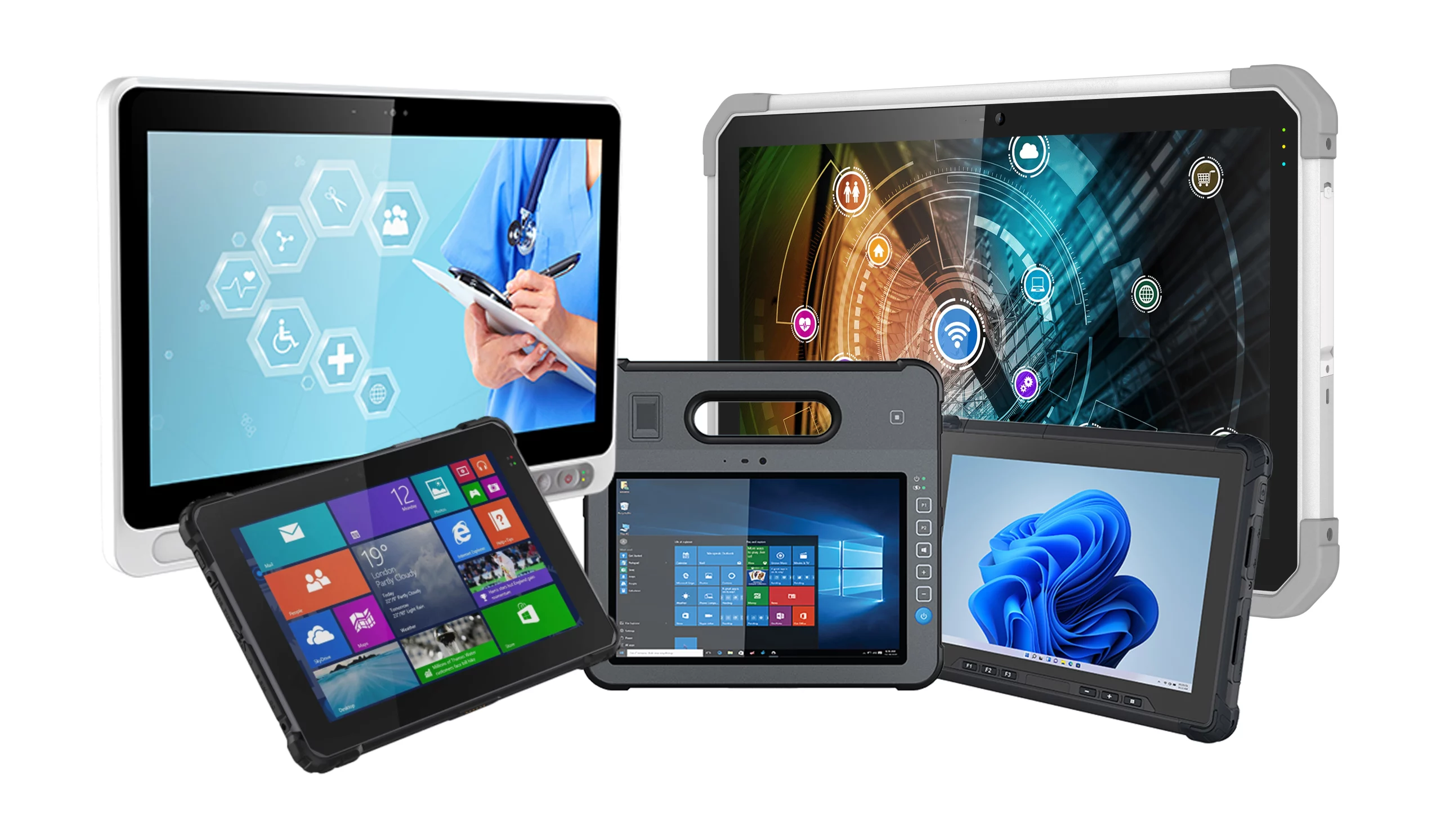
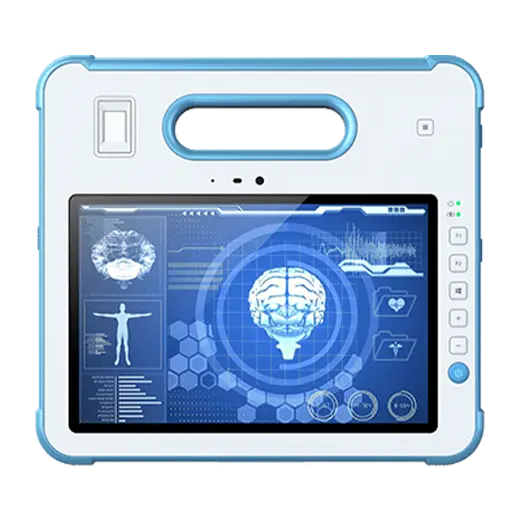
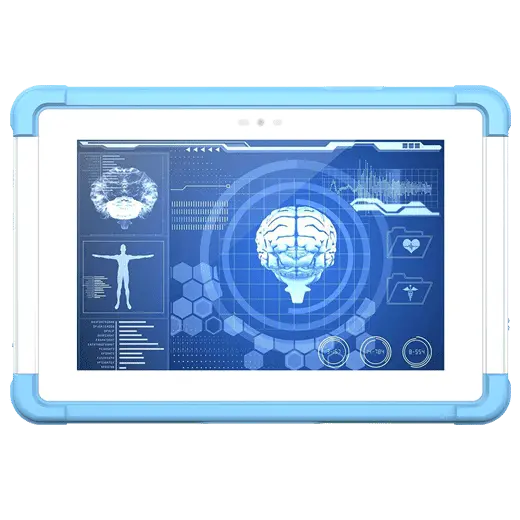
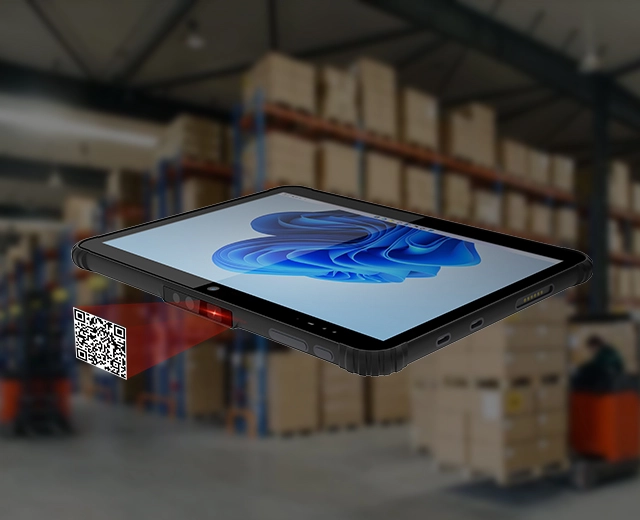
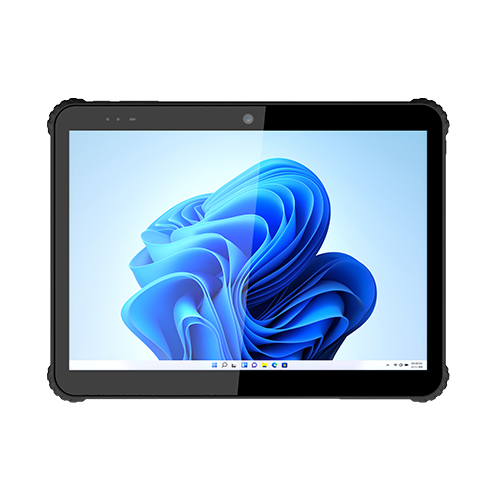
Estoneʼs Slim Rugged tablet MW-100 was designed to bridge the gap between the consumer grade tablet and the purpose-build tablets. With its slim design, lightweight and sunlight readable screen it can be used for various application. In the article Slim Yet Tough: How the MW-100 Tablet Survives the Harsh Warehouse Environments you can find the specific features that make this exact model suitable for warehouse management and logistics. Here we want to bring your attention to the ways you can implement MW-100 in your own warehouse managing process.
Deployment patterns and recommended configurations
High-throughput picking (voice-and-scan)
In high-throughput picking workflows, the MW-100 performs best when equipped with an integrated 2D barcode scanner or a paired rugged Bluetooth pistol scanner. A configuration with Wi-Fi 6E, 8 GB RAM, and 128 GB storage ensures stable, low-latency data exchange even in dense warehouse environments.
Operators typically use a lightweight hand strap and a single-ear wired headset for efficient voice-pick tasks, often complemented by a holster for one-handed operation.
For operations exceeding 1000 scans per picker per day, a pistol-grip scanner offers superior ergonomics. To minimize radio load, itʼs recommended to configure the WMS client to batch writes rather than send every scan event individually.
When processing inbound parcels, the MW-100ʼs rear 13 MP autofocus camera can capture full label images for OCR while maintaining barcode fallback.
Mounting the tablet on a powered cart dock with USB backhaul enables local pre- processing if low latency is needed. Adding LED ring or bar lighting ensures consistent image quality.
In this setup, the captured data (barcode, OCR text, timestamp, and device ID) can reconciled server-side with inbound manifests for fully traceability.
Yard management & last‑mile driver workflows
For yard operations and last-mile delivery, the MW-100 delivers reliable mobile performance through its LTE connectivity and optional high-precision GPS pogo module. Mounted in a magnetic vehicle cradle with integrated charging, the tablet ensures uninterrupted operation during vehicle movement and quick detachment when needed for on-site use. A rugged holster complements the setup for hands- free mobility.
In environments with weak cellular coverage, using a cradle with external antenna pass-through greatly improves LTE reception. For drivers operating in noisy settings, an external microphone enhances audio clarity during voice communication or proof-of-delivery (POD) confirmations.
Connectivity remains stable on the move by configuring seamless handoff between Wi-Fi and LTE. Applications should support local caching and retry mechanisms, ensuring that critical data such as signed PODs are securely stored and synchronized once connectivity resumes.
RFID receiving & bulk inventory
For facilities managing high-volume receiving or bulk inventory control, the MW- 100 can serve as a powerful RFID controller. When equipped with the pogo-pin RFID module -ODM option) and, if required, an external UHF antenna, the system achieves reliable tag reads even across extended ranges. Integration with Windows-compatible RFID middleware allows the device to filter and validate tag data locally before forwarding it to the warehouse management system (WMS), minimizing redundant server processing and network traffic. In this configuration, operators can execute rapid read bursts, automatically pre- filter tag data, and maintain precise control over which reads are transmitted upstream, streamlining both accuracy and throughput.
Network architecture, security and manageability
A robust network foundation is essential for realizing the full performance of the MW-100 across warehouse and logistics environments. In RF planning, the 6 GHz band should be treated as an additional capacity layer ideal for dense zones where 5 GHz channels are already saturated. Before deployment, test access point handoff across aisles and vehicle paths to ensure seamless roaming, particularly for mobile WMS clients running on forklifts or dock vehicles. Where low reauthentication time is critical, features such as 802.11r/k/v can significantly improve roaming stability. To maintain consistent throughput, backhaul design must prevent uplink congestion and prioritize time-sensitive traffic such as voice pick data, acknowledgment packets, and telemetry. Implementing switch and AP-level QoS helps preserve low latency and reliable performance across the network. From a security and manageability perspective, MW-100 tablets benefit from enterprise-grade protection through TPM 2.0 and BitLocker encryption, ensuring that data at rest remains secure. Devices should enroll automatically through Windows Autopilot or a mobile device management (MDM) platform to establish identity, enforce configuration baselines, and enable remote wipe capabilities. Integration with your identity provider further enables conditional access based on compliance status.
Firmware management should follow a controlled release process, testing BIOS, firmware, and driver updates separately from application updates before large- scale rollout. Finally, ensure that no personally identifiable information (PII) is stored unencrypted in images or logs. When offline caching is necessary, use encrypted containers and purge them automatically once synchronization is confirmed.
Integration, middleware and application considerations
Successful deployment of the MW-100 depends on robust integration across driver stacks, scanning workflows, and data pipelines. For system integrators, building a stable foundation starts with the golden image bundling all necessary driver packages, including those for scanners, LTE modules, and pogo-pin accessories. Each image should be validated against actual hardware to verify driver signatures and COM port mappings before rollout. In environments requiring high scanning throughput, a dedicated pistol-grip scanner offers superior ergonomics and reliability. The warehouse management client should be configured to handle asynchronous scan events and use local queueing when server latency exceeds 100-200 milliseconds, ensuring uninterrupted task flow. When integrating camera-based OCR workflows, the MW-100ʼs rear camera should capture at the highest practical resolution, with skew correction and contrast normalization performed either on-device or at a nearby edge node. This approach reduces bandwidth use and avoids sending large raw images over LTE connections. To safeguard data integrity during network interruptions, applications should implement a durable local database to act as a persistent write-ahead queue. Back-end services must support idempotent reconciliation to prevent duplicate entries once connectivity is restored. For telemetry and event reporting, compact communication protocols like MQTT or compressed HTTPS payloads are recommended. Adaptive batching of transmissions helps minimize radio usage and maintain consistent network efficiency during operational peaks.
Reliability, maintenance and spare-pool sizing
Long-term reliability is central to sustaining productivity in logistics environments. For most fleet deployments, maintaining a spare device pool of 5%/10% of the active fleet ensures seamless continuity during maintenance or repair cycles. For example, a deployment of 200 tablets should reserve approximately 10 units as operational spares. Preventive maintenance should follow a structured cadence: monthly firmware health checks to ensure devices remain compliant and secure, quarterly assessments of battery health and capacity, and annual inspections of physical components such as holsters, docking connectors, and pogo-pin contacts. Tracking operational metrics like mean time between failures (MTBF) and mean time to repair (MTTR) allows organizations to refine their spare pool strategy and predict lifecycle costs more accurately. Over time, this data-driven approach helps optimize availability, reduce unplanned downtime, and extend the overall service life of the MW-100 fleet.
The Estone MW-100 offers a rare balance of rugged reliability and lightweight flexibility, making it a strong fit for modern warehouse and logistics operations. By aligning deployment configurations with your workflow needs—whether in high-throughput picking, cross-dock management, or last-mile delivery—you can fully leverage the MW-100ʼs capabilities. With proper integration, network planning, and maintenance, this slim yet tough tablet becomes a long-term asset that drives efficiency, traceability, and uptime across your logistics ecosystem.
Contact For Personal Quote
Stay updated with Estone's latest product solution and technology. Subscribe to our Newsletter. Mail us: info@estonetech.eu